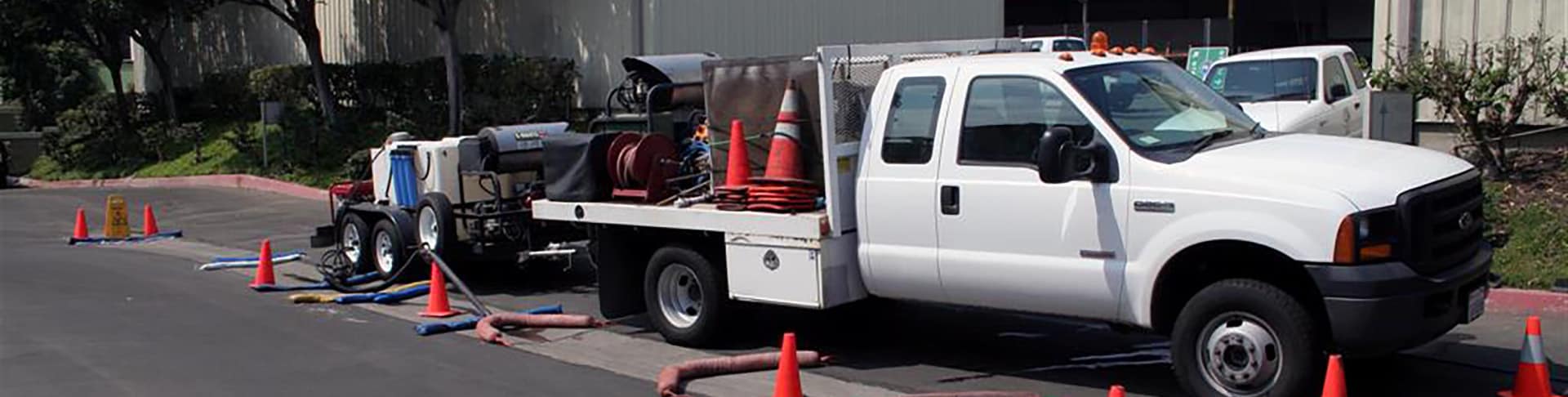
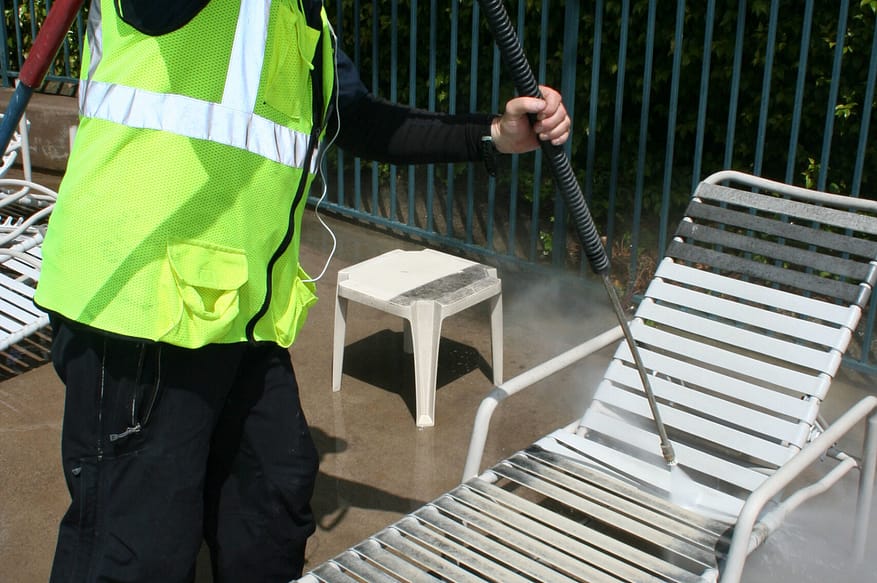
Clean walkways, storefronts and entries are the first thing your customers and tenants see. Alongside our industrial steam cleaning, we are also excited to offer hot water power washing to captivate your customers with an unparalleled level of cleanliness. Regardless of what dirt, grime, or graffiti you are dealing with, our steam and power washing teams can take care of it.

Advantages of Hot Water Powerwashing
Hot water power washing, also known as hot water pressure washing or steam cleaning, is a cleaning method that uses high-pressure hot water to remove dirt, grime, grease, and other stubborn substances from various surfaces.
When it comes to hot water power washing, recognizing the compatibility of the surface you intend to clean is essential. Similar to the considerations needed for steam cleaning, not all materials can safely withstand the aggressive combination of high temperature and high pressure that hot water power washing involves.
Surfaces made of delicate materials, or those prone to damage from heat or intense pressure, require careful evaluation before proceeding with this cleaning method. Materials such as soft wood, certain types of siding, and specific coatings or finishes might be adversely affected by the process. This technique combines the cleaning power of high temperature and high pressure to effectively clean and sanitize outdoor and indoor areas. Here are some of the benefits:

Effective Cleaning
The combination of high pressure and high temperature makes this method highly effective at removing tough stains, oil, grease, and even graffiti from surfaces.

Sanitizing Ability
The hot water can kill bacteria, algae, mold, and other pathogens, making it an excellent choice for areas that require not just cleaning but sanitizing too, like food service areas or dumpsters.

Faster Drying
Because the hot water evaporates more quickly than cold water, surfaces tend to dry faster after cleaning, reducing downtime.

Environmental Friendly
Hot water power washing can be more eco-friendly, as the heat reduces the need for chemical cleaners in many cases.

Chemical-Free Cleaning
Hot water power washing can use only water when necessary, making it a safe, non-toxic alternative to traditional cleaning methods that rely on chemical products. It’s safe for families, pets, and the environment.

Versatility
It can be used on a variety of surfaces, including vinyl and fabric awnings, wood, concrete, natural stone, painted surfaces and glass

Deep Cleaning
Hot water power washing penetrates deep into surfaces, providing a thorough clean that removes more dirt and grime than conventional cleaning methods.

What Are the Differences Between Steam Cleaning and Hot Water Powerwashing?
Steam cleaning and hot water power washing are both effective methods for cleaning commercial spaces, including parking lots and other industrial applications. While they share the goal of deep cleaning and sanitizing surfaces, there are distinct differences in their mechanisms, applications, and suitability for various tasks.
Understanding these differences is crucial for selecting the most appropriate method for a given cleaning requirement.
Hot water power washing stands out for its ability to handle the rigorous demands of outdoor environments. This method combines high pressure with hot water to effectively remove tough stains, dirt, grease, and grime from hard surfaces.
It is particularly suited for large, open areas where the primary concerns include removing heavy buildup and preparing surfaces for treatments like painting or sealing. The thermal aspect of hot water enhances its cleaning capabilities, making it adept at breaking down oily and greasy substances, which are common in commercial and industrial settings.
On the other hand, steam cleaning, while offering deep cleaning and sanitizing benefits through high-temperature steam, is generally more suited to specific outdoor scenarios where minimal water use and chemical-free cleaning and sanitization are priorities.
Ultimately, the decision should factor in the specific cleaning requirements, environmental considerations, and the nature of the surfaces to be cleaned to achieve optimal results while preserving the integrity of the property.

What Environmental Steps Do You Take?
Our commitment to the environment goes beyond merely reducing the usage of harsh degreasers. We take proactive steps to mitigate environmental harm by efficiently managing water runoff, a principle that applies to both our steam cleaning and hot water power washing services.
Utilizing advanced industrial vacuums, our team is equipped to capture, filter, and reclaim water, significantly minimizing our ecological footprint. This practice not only ensures we limit waste but also aligns with the Stormwater Pollution Prevention Plan (SWPPP) guidelines, showcasing our dedication to sustainable cleaning methods.
For each project, we meticulously assess the best approach to diminish our environmental impact while fully complying with California’s stringent pollution standards. Our goal is to deliver unparalleled service without compromising our environmental responsibilities.

Why Should I Have This Service?
Customers often make their first judgments based on the cleanliness of a property, influencing their choice of where to shop or which businesses to engage with. While many businesses invest in keeping their interiors modern and tidy, enhancing your property’s exterior with steam cleaning can significantly distinguish you from your competitors.
The presence of traffic stains in your parking lot or on sidewalks is quickly noticed, even by passersby. Similarly, graffiti or acts of vandalism can tarnish your business’s image, making it seem unprofessional or insecure. Utilizing RueVac’s industrial steam cleaning services, you have the opportunity to uphold an immaculate and appealing exterior, creating a positive and lasting impression on potential clients and customers.
Ready for a Cleaner Business?
If you need a commercial pressure washing company in Orange County, Los Angeles, Riverside or San Bernardino Counties, then take advantage of the best technicians and highest quality steam cleaning services in southern California. Call RueVac Property Services today at 714-998-0191 to learn more about our reputable company and how we can help you improve the look of your business.
Get an Estimate
Frequently Asked Questions
What's the difference between hot water power washing, pressure washing, and steam cleaning?
They sound interchangeable, but the difference comes down to heat and pressure. Pressure washing uses cold water at high pressure. It relies on brute force, which is fine for loose dirt and mud but struggles when you hit grease or oil. Hot water power washing adds heat to that pressure, and heat is what actually breaks down oils, grease, gum, and food residue. That’s why it’s the workhorse for commercial concrete: drive-thrus, entryways, dumpster pads, and walkways where grime is baked in. It also sanitizes as it cleans. Steam cleaning runs very hot at low pressure and volume. It’s gentle and great for sanitizing or delicate surfaces, but it’s slow over large areas. For most commercial exterior work, hot-water power washing is the right tool because it combines the cleaning power of heat with the coverage you need to get a property cleaned.
How often should commercial concrete sidewalks and entryways be power-washed?
- It comes down to traffic and whether food is involved. Anywhere food is in play, food courts and restaurant patios, the concrete, brick, or stone takes the worst of it and needs weekly to twice-monthly cleaning to keep grease, gum, and stains from setting in permanently. Grocery entries, high-volume majors, and ATM areas run twice monthly to monthly. Back walkways and dumpster enclosures land in that monthly to twice-monthly range too, and any enclosure handling food gets cleaned more often. General shopping center walkways are usually fine monthly, while outlying low-traffic areas stretch to quarterly or twice a year. Business parks fall in that same quarterly-to-semiannual range, and parking structures are typically once a year. The rule of thumb: the more food and foot traffic an area sees, the more often it needs cleaning, because that’s where stains set in and turn permanent.
Can hot water power washing remove oil stains and grease from a parking garage floor?
- Most of it, yes, but it’s worth being honest about the limits. Hot water plus a commercial degreaser is very effective on grease and oil, because the heat and the surfactant work together to break the oil down and lift it off. Fresh and moderate staining comes up well. The harder case is old oil that has soaked deep into bare concrete. Concrete is porous, so once oil has penetrated over months or years, washing the surface clears what’s on top, but a deep stain may only lighten rather than vanish. For those we can step up to a longer degreaser dwell, agitation, or a poultice that pulls oil back out of the pores. Sealed floors clean up far better than bare concrete. We’ll always tell you up front what will fully come out versus what will improve but not disappear, so you get no surprises.
How do commercial power washers manage water runoff for SWPPP compliance in California?
This is what separates a professional from a guy with a pressure washer. Wash water isn’t clean water. It carries oil, grease, detergents, and debris, and in California it can’t legally go down the storm drain. So the whole job is built around capturing and reclaiming it. Before we start, we block and protect the storm drain inlets so nothing escapes into the system. We berm the area to control where the water goes, then use a vacuum recovery system to pull the dirty water up off the surface. That reclaimed water is disposed of properly, to the sanitary sewer where allowed or hauled to an approved facility, never to the gutter. We use biodegradable detergents wherever we can. Done right, your property gets clean and not a drop of contaminated water reaches the storm drain or the ocean it feeds.
What surfaces should never be hot water power washed?
Here’s the truth most people don’t hear: with an experienced operator, almost any surface can be cleaned beautifully. The equipment is incredibly powerful, and that’s exactly the problem. In the wrong hands it does real damage fast. The surfaces that punish inexperience are stucco, old brick and mortar, wood (especially painted or aged), window glass and seals, fabric awnings, and anything electrical like fixtures, cameras, and outlets. Roofing is a hard no. Even soft concrete can be permanently etched by someone who doesn’t know how to finesse the machine. None of that means these surfaces can’t be cleaned, it means they demand patience, the right settings, and a technician who knows what they’re doing. So the real question isn’t which surfaces to avoid, it’s who you hire. Look for a company that has worked in this space a long time, can show you photos of detailed work on surfaces like yours, and carries serious insurance in case something goes sideways.
Can hot water power washing remove graffiti without damaging the underlying surface?
- Sometimes it’s the right tool, sometimes it isn’t, and a good company tells you which. We match the method to the surface and how set-in the paint is. A resilient surface can often be cleaned with a graffiti remover chemical and a rag, no power washing at all. A painted surface is usually best handled by color-matching and repainting, cheaper and far less likely to cause damage than washing it off. On unpainted brick, fresh graffiti comes off with a chemical and hot water power washing. The older the paint, the harder it has set into the surface, and that’s where wet sandblasting wins. A patient operator using a fine sand injection system lifts the paint and, with multiple passes, blends the area so well you’ll never see where it was. Not every power washer has this range. Hire one who does, and who’ll recommend the right method even when it isn’t their own service.
How long does it take for surfaces to dry after a commercial power wash, and when can foot traffic resume?
Faster than most people expect, which is one of the advantages of hot water. The heat speeds evaporation, so hard surfaces like concrete walkways usually dry within thirty minutes to a couple of hours depending on temperature, humidity, and sun. In practice, foot traffic can often resume as soon as the standing water is cleared and the surface isn’t slick, sometimes almost immediately on textured concrete. The bigger point is timing. We schedule most power washing overnight or early morning, so by the time the property opens the surfaces are dry and safe and tenants never deal with wet walkways or closed-off entries. Weather is the main variable. A cool, humid morning dries slower than a warm, breezy one. If we’re cleaning during business hours, we cone off the area and manage runoff so foot traffic stays safe while it dries.
Will hot water power washing damage paint, sealants, window seals, or stucco on a commercial building?
- It can, and that’s a fair thing to ask before letting anyone near your building. Used wrong, high pressure will chip paint, blast caulking and sealant out of joints, break window seals and force water into the frames and walls, and etch or gouge stucco. The reassurance is that none of that happens when the work is done right, because protecting those surfaces comes down to technique. Near windows and seals, we drop the pressure and adjust the angle so water never drives behind the glass or into the frame. On stucco and painted walls, we switch to a soft wash, letting low pressure and the right cleaning agent do the work instead of brute force. We keep the wand moving, hold the proper distance, and test an out-of-the-way spot first. Done by an experienced crew, your paint, sealants, seals, and stucco come through untouched. The horror stories almost always trace back to someone running full pressure on everything.
“We have been using their services for a MANY years now. They are always very professional and provide an excellent service for us.”

“We use RueVac at just about all of our Southern California properties. They have always done an amazing job at being responsive to our service requests while completing them in a detailed and professional manner.
They are highly dependable and proactive as well. I’d recommend RueVac for any of the many services they provide.”

“RueVac service goes above and beyond any vendor I have worked with. They are responsive, provide solutions to issues, work within your budgets, and exceed expectations every single time.
I have used them for various services such as fence repairs, graffiti removal, homeless encampment clean-up, exterior window cleaning, parking lot sweeping, and misc. services.”

“I have had the pleasure of working with RueVac Property Services for the past 4 years – and counting (in particular, with Ms. Hayley Perez). It is always a pleasure to work with Hayley. Her upbeat personality and positivity are refreshing. Regardless of how busy she may be, Hayley always responds rapidly and with the utmost professionalism.
And, no matter the circumstances or difficulties that the day may bring, there’s always a smile in her voice.
10 out of 5 stars!”

“It seems hard to find a company that can offer and perform services to the same standard, regardless of the service. RueVac is an exception to this and continues to amaze me and my team by delivering exactly what we need for all services we contact them for.
Thank you RueVac team for making our properties up to our standards and continuing to provide the great customer service that is needed for our team.”

“Partnering with you to be more than just a vendor but a valuable part of your team.”
Ronald K. Lyons - Founder
Trusted By

Service Area